Madrid · Spain
DOOH in Madrid: the screens on the street, counted
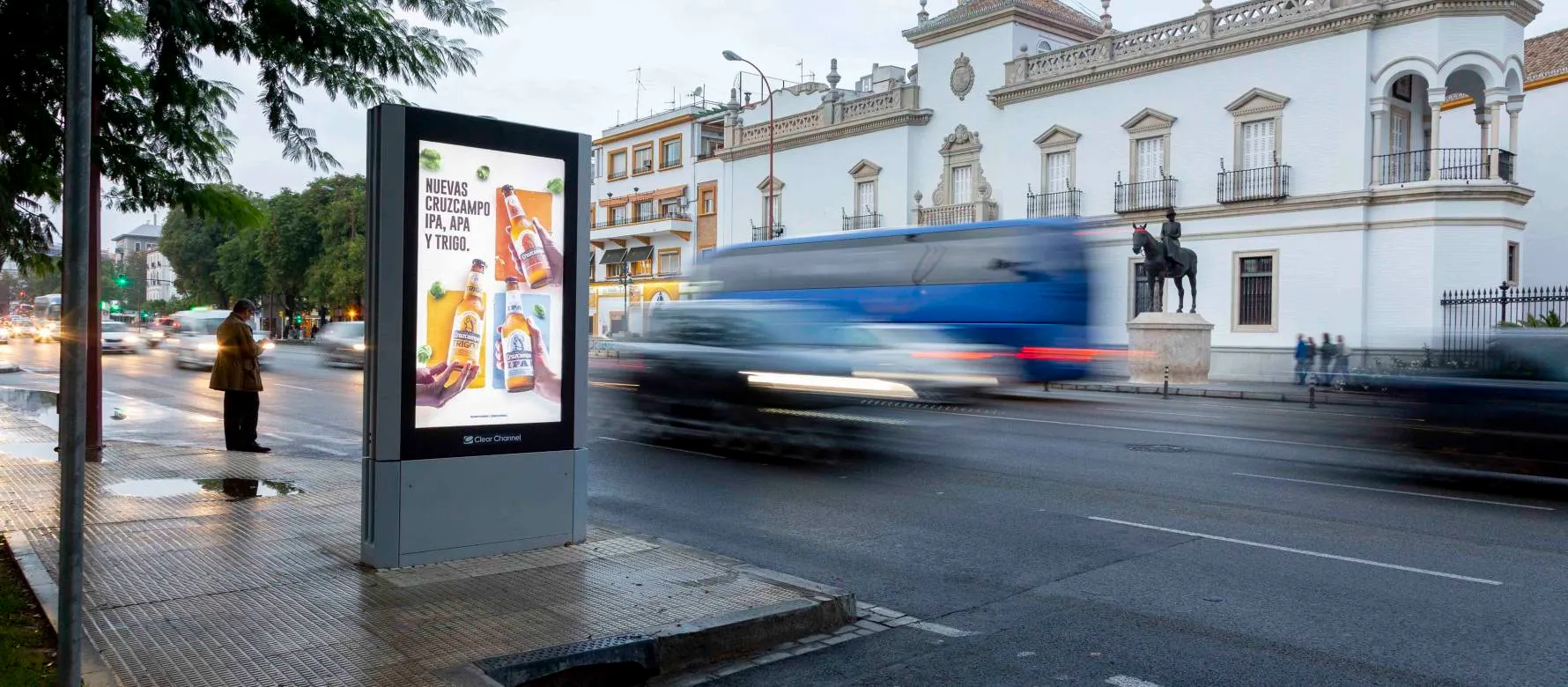
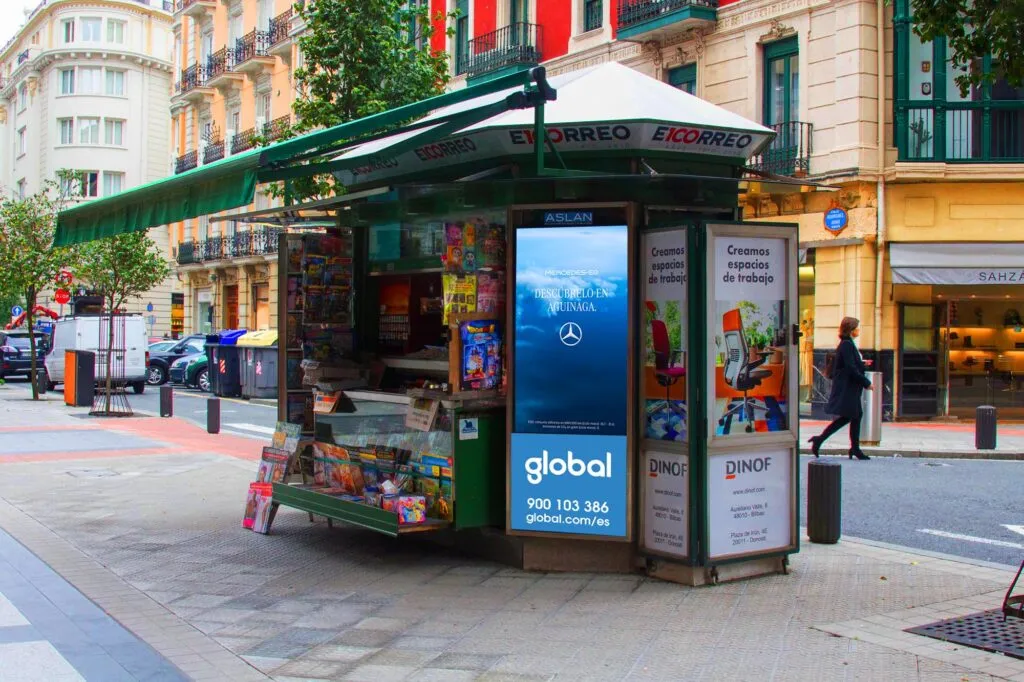
Madrid does the opposite of Paris. Where the French capital pushed digital off the pavement and behind the glass, Madrid keeps it on the street and lights it: 850 of the 1,800+ screens glooh books here are street furniture across 490 positions, against 750 in a Paris network four times the size. The rest is underground and indoors: 300 screens in the metro, 180 in rail stations and the big transport interchanges, 250 in shopping galleries and 150 in gyms. A campaign opens at €450 per week.
Inventory current as of 2026-08
Madrid
1,800+ screens mapped
Inventory current as of 2026-08
Explore Madrid in the simulator →- 500
- Transit
- 300
- Retail
- 850
- Outdoor
- 150
- Health & beauty
850
screens across 490 locations
In Madrid the street is the medium
Street furniture is not a supporting line in this market, it is the market: 850 screens over 490 positions, roughly half of everything bookable in the city. Gran Vía, the Castellana from Atocha up to Cuzco, Serrano in the Barrio de Salamanca. If you have been told that European capitals are closing their pavements to digital advertising, that is a Paris sentence, and it does not travel south.
One city, two axes
Madrid is not planned from a centre outwards, it is planned along two lines that cross once. Which line you buy decides who sees you, and it is the decision an inventory list will never make for you.
- 01 850 screens
The walking axis
Puerta del Sol into Preciados and Calle del Carmen, up to Callao and along Gran Vía to Plaza de España. Dense, slow, shopper and visitor heavy. Street positions and the car-park entrances under the squares.
- 02 850 screens
The driven axis
The Paseo de la Castellana running south to north: Atocha, Cibeles, Colón, the AZCA offices at Nuevos Ministerios, Plaza de Castilla. Fast, corporate, seen from a car. This is the business audience.
- 03 300 screens
Underground, between the two
300 screens across 90 metro stations, the layer that connects both axes and the one Madrid actually rides.
- 04 180 screens
The interchanges
180 screens in rail stations and the transport interchanges, where the commuter flow from outside the city concentrates before it disperses.
Zones across Madrid
Each zone is a real catchment: its screens, its venues, its audience.
Chamberí and Tetuán
340 screens
The middle of the driven axis, and the largest zone on the page: 340 screens across 130 venues. Chamberí's high streets, where madrileños shop rather than visitors, then the AZCA office district at Nuevos Ministerios. The perimeter holds 116 supermarkets and 36 gyms: it is a working, living part of the city, not a business park.
Points of interest in the zone:
81 schools · 19 universities · 36 gyms · 24 stations · 116 supermarkets · 1 mall
Moncloa-Aravaca and Fuencarral
310 screens
The north-west, and the zone with the widest spread: 310 screens over 110 venues from the Moncloa and Príncipe Pío interchanges out to the shopping centres of Fuencarral. 48 higher-education sites sit inside the perimeter, more than in any other zone, because the Ciudad Universitaria campus is in it.
Points of interest in the zone:
158 schools · 48 universities · 33 gyms · 32 stations · 85 supermarkets · 12 malls
Salamanca and Retiro
300 screens
Two very different halves of the same buy. 160 venues carry 300 screens, more locations than any other zone here: Serrano and the luxury grid of the Barrio de Salamanca on one side, the museum mile and the streets around the Retiro on the other. Local wealth, international residents and cultural visitors, three metro stops from Gran Vía and a completely different audience.
Points of interest in the zone:
67 schools · 11 universities · 34 gyms · 20 stations · 70 supermarkets · 2 malls
Centro and the walking axis
210 screens
The distrito that holds the walking axis: Puerta del Sol, Preciados, Callao, Gran Vía and Plaza de España, plus the entrances of the underground car parks beneath the central squares. 210 screens over 110 venues in five square kilometres, the densest perimeter on this page and the one a Spanish plan usually opens on. Read it as footfall rather than as reach: nobody drives through here.
Points of interest in the zone:
62 schools · 25 universities · 31 gyms · 20 stations · 64 supermarkets · 3 malls
Chamartín
190 screens
The north end of the Castellana: the stadium, Plaza de Castilla, the towers and Chamartín station, 190 screens over 70 venues. This is where the driven axis is at its most corporate, and where one of our three large exterior LED positions stands.
Points of interest in the zone:
82 schools · 12 universities · 10 gyms · 12 stations · 46 supermarkets · 2 malls
The southern districts
190 screens
Arganzuela, Carabanchel, Latina, Usera, Villaverde and the two Vallecas: 190 screens over 80 venues, against 280 supermarkets and 424 schools inside the perimeter. The ratio is the point: this is where a third of the city lives and does its weekly shopping, and where our count is thinnest relative to the population. Buy it for local reach, not for saturation.
Points of interest in the zone:
424 schools · 16 universities · 87 gyms · 70 stations · 280 supermarkets · 18 malls
Leganés and Pozuelo de Alarcón
120 screens
Two neighbouring municipalities the capture reaches, Leganés to the south and Pozuelo de Alarcón to the west: 120 screens over 60 venues, mostly retail and transport. They are separate towns rather than districts of Madrid, which matters when someone asks whether a "Madrid" buy includes them. Here it does, because we count what the survey reached.
Points of interest in the zone:
135 schools · 16 universities · 23 gyms · 25 stations · 71 supermarkets · 14 malls
The eastern districts
110 screens
San Blas-Canillejas, Hortaleza, Ciudad Lineal, Moratalaz and Barajas: 110 screens over 35 venues. The fairground and the airport are both inside this perimeter geographically, and neither carries our screens, so treat this zone as residential east Madrid rather than as an airport or trade-fair buy.
Points of interest in the zone:
261 schools · 15 universities · 39 gyms · 51 stations · 161 supermarkets · 10 malls
The neighborhoods where your screens work
Sol, Preciados and Gran Vía
The walking axis and the highest footfall in the country. Street panels, the entrances of the underground car parks beneath the central squares (50 screens over 30 positions city-wide), and the Sol interchange underneath it all. Mass market, tourist heavy, and the place a Spanish media plan starts.
The Paseo de la Castellana
Atocha, Colón, Nuevos Ministerios, Plaza de Castilla: street positions strung along eight kilometres of the city's business spine, read at driving speed rather than walking speed. The B2B buy in a city where the offices are on one line.
Barrio de Salamanca
Serrano and the streets around it: luxury retail, local wealth and a large international resident population, three metro stops and a completely different audience from Gran Vía. Small in screen count, precise in who walks past.
The metro
300 screens across 90 stations. Madrid rides the metro across every income bracket, which makes it the one venue type here that does not select an audience for you.
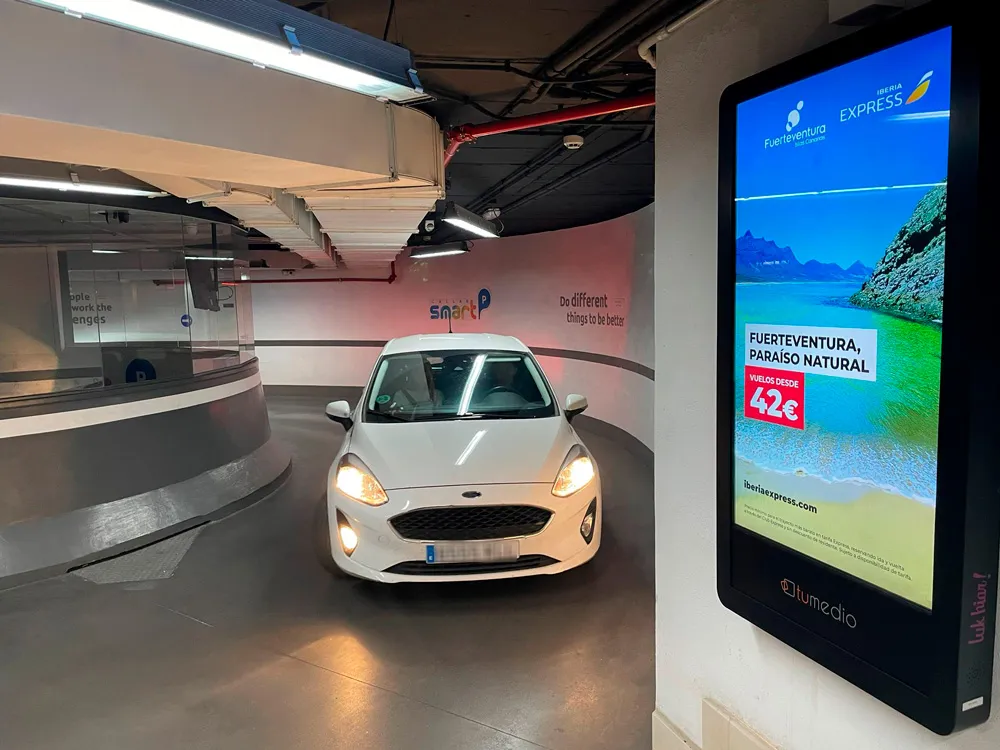
Shopping galleries
250 screens over 70 locations in hypermarket and shopping-centre galleries. Matters more here than in northern Europe for a simple reason: from June the heat moves daytime footfall indoors.
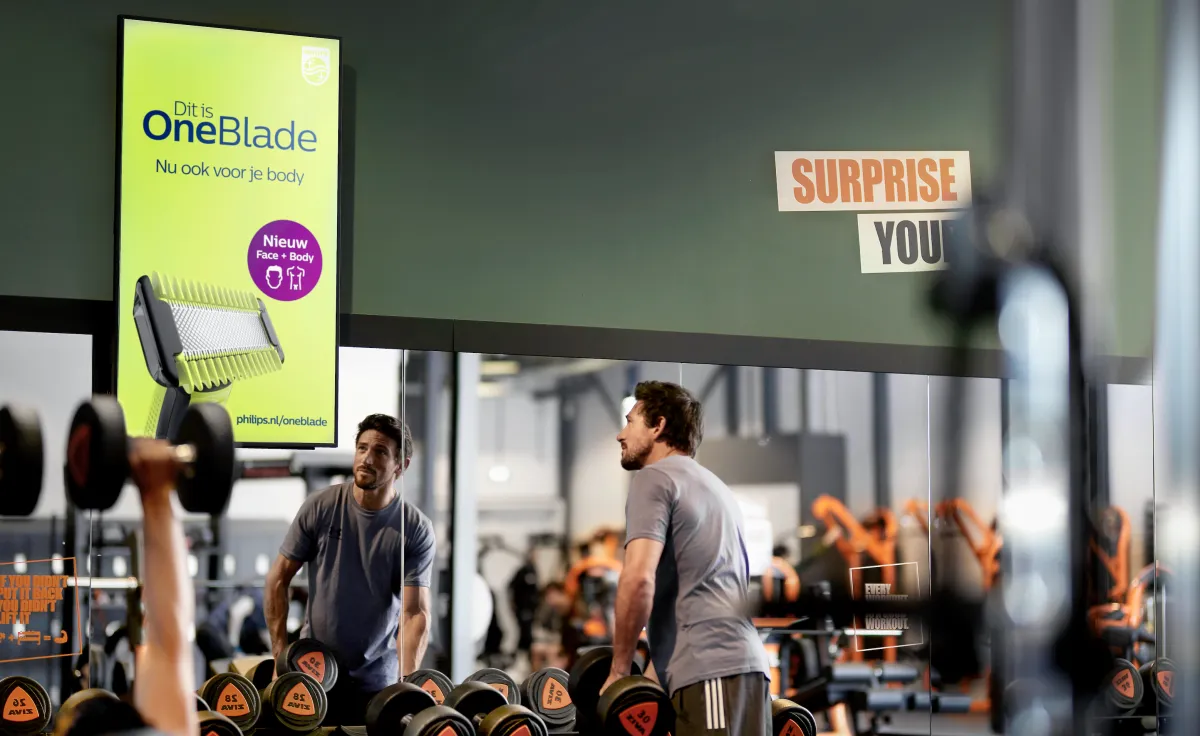
Gyms
150 screens across 40 clubs, the Basic-Fit network. The evening audience in a city that trains late, and a venue the street cannot target.
Our screens in Madrid
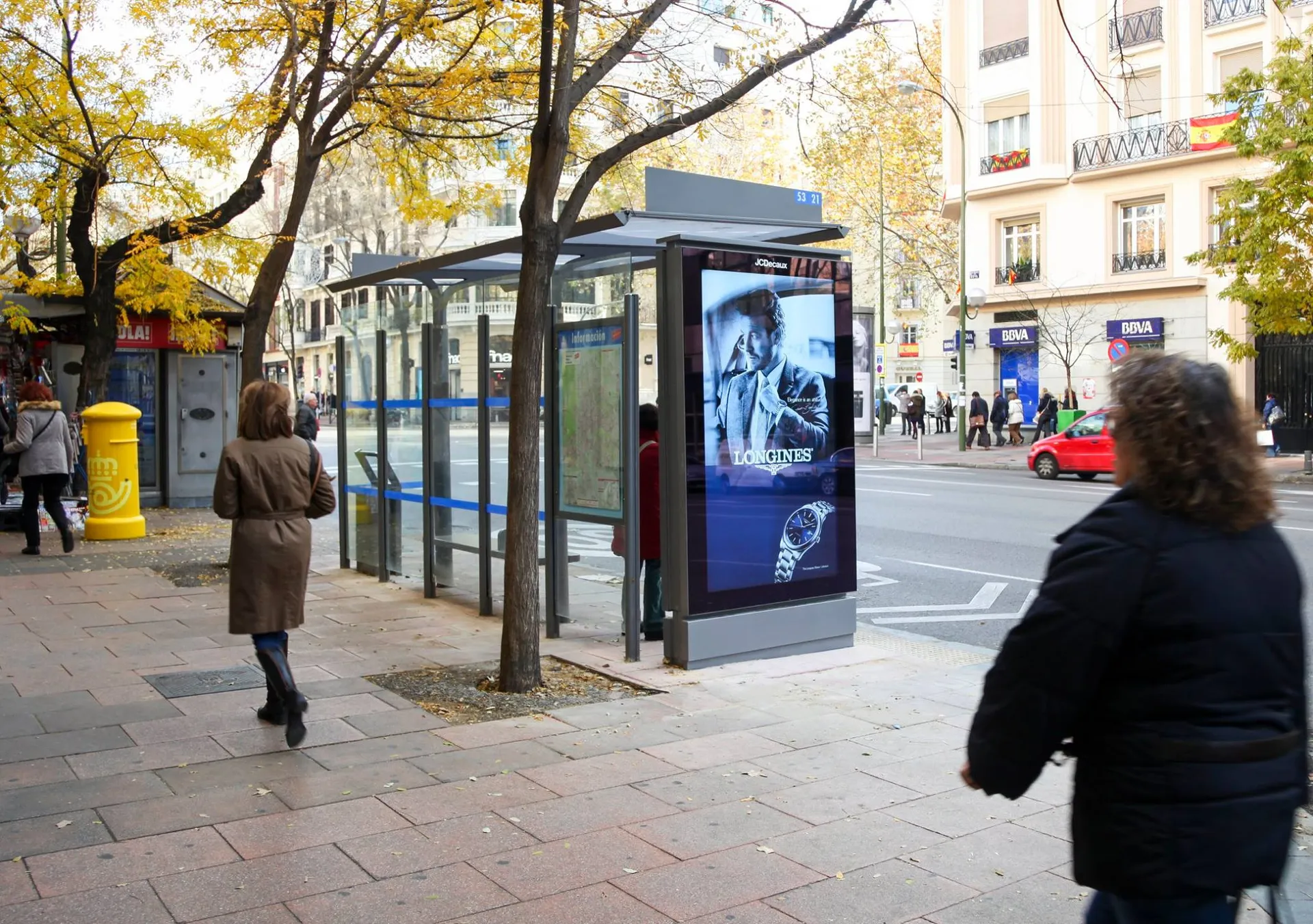
Two axes, and which one your brief needs
Almost every Madrid plan is really a choice between two lines. The walking axis runs from Puerta del Sol through Preciados and Callao along Gran Vía: pedestrian, dense, slow, shopper and visitor heavy, and the closest thing Spain has to a permanent shop window for a national brand. The driven axis is the Paseo de la Castellana, eight kilometres of offices, ministries, hotels and towers read from a car window at speed, from Atocha and the museum mile up through Cibeles, Colón and the AZCA district to Plaza de Castilla. They cross once, around Cibeles and the bottom of Gran Vía. A campaign on the first reaches shoppers and visitors, a campaign on the second reaches workers and decision makers, and the two need different creative: a pedestrian reads a sentence, a driver reads three words. Most competitor pages will sell you a screen count for "Madrid centre" without ever saying which of these two cities you just bought.
Madrid runs on a different clock, and the plan has to know it
A campaign planned on a northern European daypart misses most of this city. Madrid eats late, shops late and is busiest on the street well after dark, and in summer the whole rhythm slides further into the evening because the afternoon is too hot to be outside in. Evening and night weight here in a way they simply do not in Brussels or Antwerp, and because our screens are bought by the play rather than by the fortnight, that is a lever you can actually pull. The seasonal version of the same point: August is not a normal month. Madrid empties, and the audience that stays is not the audience that left, which makes August either the wrong month or a very cheap one depending on who you sell to. The two retail peaks are the rebajas in January and July. From June onwards, the heat is also what pushes daytime footfall into the shopping galleries, so a summer plan that only buys street positions is buying the emptiest hours of the day.
What this page sells, and what it does not
Madrid is the European city where the spectacular formats are most visible, and they are the first thing a visitor asks about: the giant building wraps on scaffolded facades, and the screens facing the square at Callao that the Spanish industry treats as its own showcase. Those are not what you are buying here. They are separate deals with separate operators, governed by the city's own outdoor advertising rules, and we would rather say so on the page than let you find out on a call. What is on this page is the bookable network: 850 street positions, the metro, the rail stations and the big interchanges, the shopping galleries, the gyms, and the entrances of the central underground car parks. Three of the street positions are large-format exterior LEDs at interchange squares, which is the closest this inventory comes to the postcard format. Everything in the strip at the top of this page comes from the same survey, dated at the top of the page, and nothing in it is a rate card number.
The Madrid rules that change what a campaign can do
- Outdoor advertising here is governed by the Ordenanza Reguladora de la Publicidad Exterior of 30 January 2009, as amended since. It covers the city of Madrid only, not the Comunidad, so a campaign in Getafe or Las Rozas answers to that town's rules.
- Screens in shop windows and on facades run from opening until 22:00, with a twilight sensor, and the permitted hours can be cut where the light causes nuisance.
- A lona on scaffolding lasts as long as the works and no longer than six months, the licence is renewable once, and the same building then waits ten years before the next one.
- Lonas need a favourable heritage opinion before they go up, including from the Comisión de Patrimonio of the Comunidad de Madrid.
- Advertising on trees, traffic signs and traffic lights is prohibited outright.
Rules checked on 24 August 2026
Frequently asked questions
- Why does Madrid start at a higher weekly price than your other cities?
- Because the mix is different, not because Spain is expensive. Half of this network is street furniture, which carries a higher unit cost than the indoor screens that make up most of a Belgian city's inventory, and there are fewer cheap positions to build a floor from. The entry point here is €450 per week against €250 in Brussels, and most two-week campaigns land between €400 and €1300. The simulator prices your exact selection before anyone talks to you.
- Does "Madrid" mean the city or the whole Comunidad?
- This page counts the city and its immediate ring, which is what a Madrid brief usually means. The Comunidad de Madrid is a region of more than six million people, and towns like Getafe, Alcalá de Henares, Móstoles or Las Rozas are separate markets with their own inventory rather than neighbourhoods of the capital. They are bookable from the same account. Tell us the towns and we will price them; do not assume they are inside a "Madrid" buy anywhere, ours or a competitor's.
- Can I buy the Callao screens or a building wrap?
- Not through this platform, and we would rather be blunt about it than take the brief and disappoint you later. The large facade screens at Callao and the lonas on scaffolded buildings are separate contracts with the operators who hold those positions. The lonas in particular are not a media format you simply book: one is tied to the rehabilitation works underneath it, it can stay up for six months at most, the licence renews once, the same building then waits ten years, and a heritage opinion has to come back favourable first. What we can do at that end of the market is the three large exterior LEDs at the interchange squares, plus enough surrounding street positions to make a perimeter feel owned.
- When should a Madrid campaign actually run during the day?
- Later than you think. The street is busiest after dark, the evening carries real commercial weight, and in summer the useful hours move even later because the afternoon belongs to the shade. Buy plays rather than days and weight them to the evening, especially if the audience is under forty or the message is about eating, going out or shopping.
- Is August worth buying?
- It depends on who you sell to, and the honest answer is that most advertisers should avoid it. Madrid empties in August: the residents who leave are the ones with money to spend, and what is left is visitors and the people working through. If your audience is tourists, it is one of the best months of the year. If it is madrileños, it is the worst, and the cheap inventory in that month is cheap for a reason.
- Do the screens reach the metro and the stations, or only the street?
- Both. 300 screens sit in 90 metro stations and 180 in rail stations and the transport interchanges, where the commuter flow from outside the city concentrates. The metro is the least selective venue in the city: everyone rides it, which is exactly why it works for a broad message and badly for a narrow one.
- Should the creative be in Spanish?
- Yes, and written for Spain rather than translated into it. Place names stay as they are in any language version, Puerta del Sol, Gran Vía, Paseo de la Castellana, Barrio de Salamanca. English works in the centre and around the luxury retail streets, where the international and Latin American audience is, and it reads as foreign everywhere else in the city.
- Can I run a campaign around a concert, a match or a fair?
- You can buy the perimeter and the dates, which is what most advertisers want: the arenas, the grounds and the fairground all pull a dated, concentrated audience that our street and transport positions sit around. What you cannot do is suggest you are a sponsor or a partner of an event you have not signed with. Naming the event or the venue in the creative is where ambush marketing rules begin, and that is a conversation for your legal team before the booking rather than after it.
Want proof? See real campaigns · How pricing works
Your screens in Madrid are waiting
Pick a neighborhood and a budget, and see your campaign before you pay a thing.