Guides & articles
How does audience measurement work in DOOH?
DOOH audience is counted per play, not per person: one ad shown once on one screen can be seen by several people at the same time. Estimates multiply plays by an impression multiplier, built from footfall counts, sensors or audience institutes such as CIM (Belgium) and ROUTE (UK), then adjusted for how likely people were to actually see the ad.
Digital out-of-home (DOOH: screens in streets, malls, stations) needs its own way of counting audiences, because it works differently from online advertising. This guide explains how the audience of a DOOH campaign is estimated, starting with the concept everything else depends on: the impression multiplier.
What is the impression multiplier?
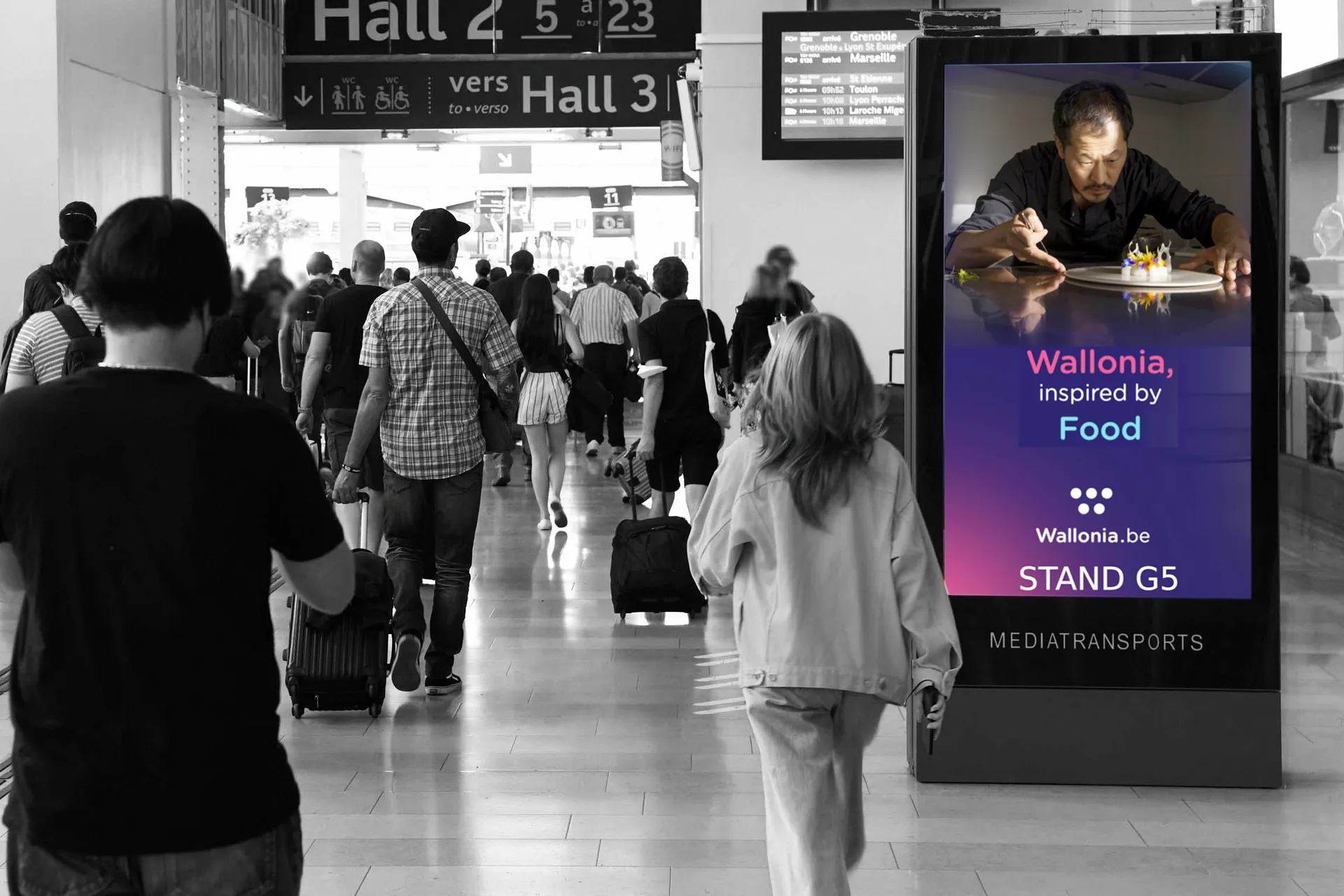
Online, 1 impression = 1 person. DOOH works on collective exposure: a single play can be seen by several people at the same time. The impression multiplier is the number of people a play reaches on a given screen at a given moment.
Illustrative orders of magnitude:
- Times Square: 1 play ≈ 1,000 potential impressions
- Shopping mall on a Saturday: 1 play ≈ 10 impressions
- Gym at 4 a.m.: 1 play ≈ 0.5 impression
“This multiplier is what makes DOOH unique. When you buy a play, you’re buying the chance to reach several people simultaneously. That’s the strength of the medium.” - 💬Dimitri, CEO of glooh
How does the multiplier change CPM?
CPM (cost per thousand impressions) has to be read differently in DOOH. You pay per play, and the number of impressions a play generates varies enormously from one screen and hour to the next.
Illustrative example: one play at €10
- Online display: 1,000 impressions → CPM = €10
- DOOH in Times Square: 100,000 impressions → CPM = €0.10
- DOOH in a gym at night: 500 impressions → CPM = €20
The lesson: a premium placement with a high price per play can still be the cheapest way to reach a thousand people, and a cheap play in an empty venue can be the most expensive.

How is DOOH audience measured?
Measurement ranges from simple counts to industry-wide models. The right method depends on the size of the network.
1. Direct methods (small networks)
- Footfall counters
- Till receipts or club badge scans
- Fuel station transactions
“These simple methods work well for local networks. They offer a clear and actionable view of audience potential.” - 💬 Max, CPO at glooh
2. Sensors
- Wi-Fi or Bluetooth sensors
- Anonymized cameras
- Motion sensors
3. Audience institutes
Industry bodies such as the CIM in Belgium or ROUTE in the UK model audiences from traffic databases combined with:
- Viewing distance
- Screen size
- Travel speed
- GPS and telecom data
Their figures are typically visibility-adjusted: they count people who were likely to actually see the screen, not everyone who walked past it.
How do you calculate the audience of a DOOH screen?
Illustrative example: a screen in a shopping mall
- Average traffic: 1,000 people per hour
- Multiplier: 3 people per play
- 1-hour campaign, 1 play every 2 minutes = 30 plays
- Potential impressions: 30 × 3 = 90
- Visibility-adjusted (70% of people in a position to see it): 63 impressions
“The multiplier is crucial for calculating ROI. The same budget can have a very different impact depending on location and timing.” - 💬 glooh Team
What does this mean for advertisers?
Choosing screens
- Large screens: reach and brand impact
- Targeted screens close to the point of sale: repetition where the purchase happens
Budget
- Compare placements on cost per audience-adjusted impression, not on price per play
- Premium placements can have very favorable CPMs despite a higher price per play
Good habits
- Ask for the multiplier behind each screen’s audience figure
- Account for hourly traffic swings when you schedule
- Combine screen types
- Check where audience figures come from before comparing offers
Can you measure DOOH like online advertising?
Not click by click. DOOH is one-to-many: nobody clicks a street screen, and pretending to attribute every exposure is how measurement loses credibility. What works is measuring the effect on an area. Compare store visits, web visits or brand lift in the zones where the campaign ran with similar zones where it didn’t. Read tactical campaigns quarterly and brand effects over a year.
That is the approach behind glooh’s campaign measurement and lift reports.
Want to try DOOH with glooh?
👉 Simulate the cost and reach of your DOOH campaign for free
For more:
Frequently asked questions
- What is an impression multiplier in DOOH?
- It is the number of people who can see a single play of an ad on a given screen at a given moment. Online, one impression is one person. In DOOH, one play can reach several people at once: a busy mall screen on a Saturday counts several impressions per play, a gym screen at 4 a.m. can count less than one.
- How do you calculate DOOH impressions?
- Multiply the number of plays by the impression multiplier for that screen and time slot, then adjust for the share of people who were actually in a position to see the ad. Illustrative example: 30 plays with a multiplier of 3 give 90 potential impressions; at 70% visibility, that is 63 visibility-adjusted impressions.
- Why is CPM calculated differently in DOOH?
- Because you pay per play while the audience per play changes from one screen and hour to the next. Illustrative example: the same €10 play costs €0.10 per thousand impressions on a screen seen by 100,000 people, and €20 per thousand on a screen seen by 500. Compare CPMs on audience-adjusted impressions, never on plays.
- Who measures out-of-home audiences in Belgium?
- The CIM, Belgium's joint industry body for media audience measurement, publishes out-of-home audience data. In the UK the equivalent is ROUTE. Smaller networks often rely on their own footfall counters, till or badge data, or anonymous sensors.
- Can you measure DOOH like online advertising?
- Not click by click. DOOH is a one-to-many medium, so single-exposure attribution is the wrong yardstick. What works is measuring the effect on an area: store visits, web visits or brand lift in exposed zones compared with similar unexposed zones, read quarterly for tactical campaigns and yearly for brand effects.